
Your own food delivery marketplace, under your brand
Connect restaurants, couriers and hungry customers on one platform: vendor menus and order tablets, a courier app built for speed, live tracking for customers — and commission settings you control, instead of a platform that taxes every plate.
What ships with this vertical
- Vendor side that works
Restaurants manage menus, prices and hours from a simple panel or tablet app; order acceptance is one tap, with auto-accept rules for rush hours.
- Courier app built for velocity
Batched orders, optimized routes, proof of delivery and instant earnings. Couriers complete more drops per hour — the metric that decides your marketplace.
- Live order tracking
Customers see cooking → picked up → on the way with a live map and accurate ETAs. Fewer “where is my order” calls, better reviews.
- Your commission model
Per-order commission, delivery fee, vendor subscription or zero-commission for your own restaurants — you set the economics; the engine enforces them automatically.
Three delivery models the engine runs — sometimes all at once
A full marketplace connects independent restaurants with your own courier fleet: the model with the highest complexity and the highest margins. An order-only platform passes orders to restaurants that deliver themselves — the fastest way to launch, ideal when courier supply is scarce. A hybrid runs both, and most successful city operators end there: owned couriers cover the dense center, vendor self-delivery covers the outskirts.
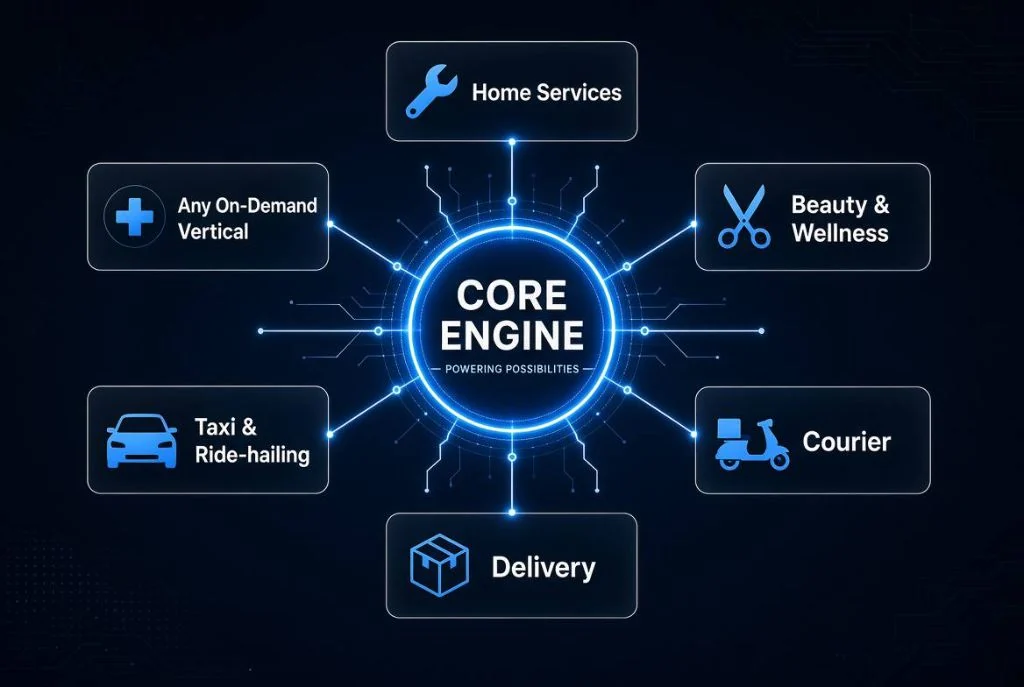
The engine treats the delivery method as an order attribute, not a separate product. The same vendor panel, the same customer app and the same admin CRM run every model — so you can start order-only in week one and switch districts to full-service delivery as your courier pool grows, without a migration project.
Courier economics: where the margin actually lives
In delivery, one number dominates profitability: courier utilization — the share of a courier’s paid time spent actually delivering. A courier at 40% utilization loses money at almost any commission rate; the same courier at 75% is your most profitable asset. Utilization is won by three mechanisms: order batching (grouping nearby orders into one run), zone density (launching where vendors cluster instead of city-wide), and route optimization that resequences multi-stop routes as orders arrive.
All three are core engine features, configured per city and per hour band. When you model your launch, model utilization first — it moves the P&L more than any commission percentage you might argue about with vendors.
Vendor success is order volume — engineer for it
Restaurants stay on platforms that bring orders and stay off ones that only take commission. The vendor side is built to make restaurants genuinely operational: a simple panel or tablet app with one-tap order acceptance, auto-accept rules for rush hours, live menu and price management, and preparation-time settings that keep the courier arriving when the food actually is.
Vendors get their own analytics — orders, ratings, best-selling items — so the platform becomes their operations tool, not just a channel. That is what reduces vendor churn, and vendor churn is what quietly kills delivery marketplaces.
The demand side: frequency beats acquisition
A customer ordering weekly is worth several acquisition-cost multiples of one ordering monthly. The retention machinery is built in: wallet and loyalty programs that work across vendors, promo campaigns with budgets and usage limits, accurate ETAs with live tracking that cut the “where is my order” support load, and ratings that keep quality visible.
Add the programmatic SEO engine — city and cuisine pages generated per market — and organic search starts feeding the order volume that vendors stay for. Demand compounds through retention mechanics, not through perpetual discounting: a promo code acquires the customer once, the wallet and the habit keep them.
What it costs — and what to model before you sign
Custom delivery platform development lands in the same range as any on-demand build: 12–18 months and $150,000+ before the first order, plus permanent payroll. The franchise path launches in 5–14 business days on a one-time license fee and a flat monthly payment — and takes 0% of your order revenue, which in delivery is the difference between a business and a commission farm.
Before signing anything, model the four numbers: contribution margin per order, orders per customer per month, courier utilization and CAC payback. Our delivery unit-economics playbook walks through the arithmetic, and Pricing & ROI shows the 24-month comparison against building it yourself.
From decision to live market
Sign up your first vendors
Menus, zones and commissions import in bulk; vendors onboard in one session with our training materials.
Build the courier pool
Onboard couriers with document checks; the app handles shifts, zones and payout preferences.
Set your delivery economics
Delivery fees, vendor commissions and promo budgets — configured per zone and hour band.
Go live and iterate
Launch city-wide, watch the analytics, tune fees and zones from the admin panel as the market teaches you.
Business, not software
Questions operators ask about this vertical
Can restaurants have their own tablets and printers?
Yes. Vendors can work from a browser panel, a tablet app or an auto-accept flow — with order printing supported.
Do couriers need to schedule shifts?
Shifts are optional. Configure open pools, scheduled shifts or zone-based availability — the courier app supports all three.
Can we start with just our own restaurants?
Yes. Many operators launch with owned or partner restaurants first, then open the marketplace to the city when courier density is ready.
Launch a food delivery marketplace in your city?
See a live demo and receive launch terms for your market within 48 hours.