
Launch your own ride-hailing service in days, not months
A complete taxi platform under your brand: passenger apps for iOS, Android and web, a driver app built for speed, real-time GPS dispatch and dynamic pricing. Uber-class mechanics for your city — without a 12-month development budget.
What ships with this vertical
- Real-time GPS dispatch
Automatic and manual order allocation, driver clustering by zone, live tracking for passengers and dispatchers.
- Dynamic & surge pricing
Per-km, per-minute, fixed-fare, surge zones and night rates — configured per city, changed from the admin panel in minutes.
- Driver experience first
One active order per screen, one-tap accept, built-in navigation, instant earnings view. Drivers onboard in minutes and stay.
- Payments any way your city pays
Card, cash, in-app wallet, corporate accounts and local gateways — multi-currency with automated driver payouts.
Three taxi business models — pick the one that fits your market
Before choosing software, decide what kind of operator you are. A fleet operator owns vehicles and drivers and needs dispatch that maximizes utilization of his own cars. A dispatcher for independent drivers runs no cars at all — he aggregates self-employed drivers who bring their own vehicles and pays them per completed order. A market operator does both: his own core fleet guarantees minimum coverage, while partner drivers fill demand peaks.
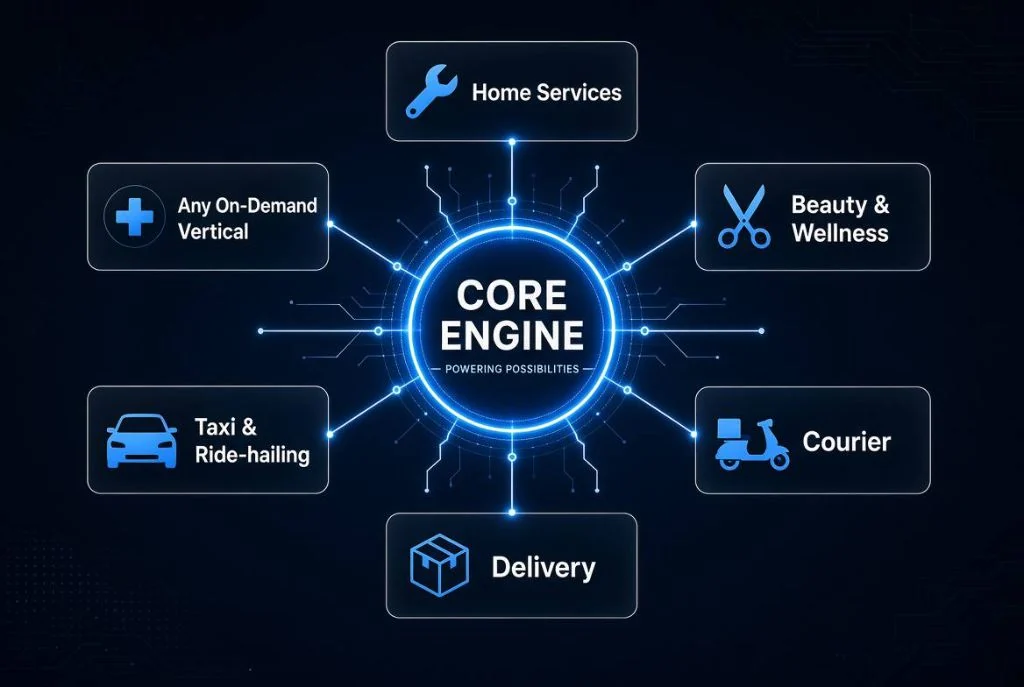
Quant Core Engine supports all three on the same deployment: mixed fleets with different payout models, partner fleets with their own zones, and aggregator pools with open registration. The model you choose determines your capital requirements more than any other decision — a fleet of 20 cars is a different business from a 200-driver pool, even though the passenger sees the same app.
Where the money actually comes from
Ride commission is the obvious revenue line, but mature operators stack several: per-ride commission from partner drivers, corporate accounts billed monthly to companies whose employees ride on invoice, surge and night-rate margins in high-demand windows, driver subscription tiers that trade lower commission for a flat weekly fee, and in-app advertising placements for local businesses once your order volume justifies it.
The engine supports every line natively: tariff and commission logic per city and per hour, corporate portals with monthly invoicing, driver wallets with automated payouts, and promo machinery that protects margin through usage limits and budgets. Which combination works best depends on your city — the demo includes a regional revenue-mix breakdown you can adapt.
The dispatch quality bar — what “good enough” actually means
Passengers forgive a plain interface; they do not forgive a 15-minute ETA that becomes 30. Dispatch quality shows up in three measurable places: allocation logic that matches the nearest suitable driver instead of a theoretical optimum, ETA honesty that recalculates live from GPS and traffic instead of quoting best-case numbers, and surge zones that move supply to demand before queues form rather than after.
The Friday-night test is the one that matters: simultaneous demand spikes across the city, drivers going offline mid-shift, card payments lagging. An engine that has survived this in production — like the Quant core — behaves differently from a first-codebase build, where these nights are when rewrites begin.
Compliance is a configuration, not an obstacle
Most cities require driver background checks, vehicle inspections, permits or their local equivalents. The engine bakes document collection into driver onboarding: uploads, expiry tracking, admin approval workflows and automatic suspension of non-compliant drivers — configured to your jurisdiction’s rules during deployment, not bolted on later.
Your lawyer handles the local licensing; the platform handles the tooling that keeps every driver on the road compliant and auditable. That division of labor is deliberate: you should never discover a compliance gap through a regulator instead of your dashboard.
What it costs — and when it pays back
The honest math: custom ride-hailing development typically runs 12–18 months and $150,000+ before the first paying passenger, with permanent engineering payroll after that. The franchise path compresses time-to-market to 5–14 business days for a one-time license fee plus a flat monthly infrastructure payment — with 0% commission on your orders, ever.
Payback speed then depends on the levers you control: driver supply density, acquisition cost and repeat rate. We model the 24-month economics for your specific city during the demo — see Pricing & ROI for the cost model and the launch playbook for the operator checklist.
From decision to live market
Configure your tariff model
Per-km, time-based, fixed or bidding — we set up the fare logic your market already understands.
Onboard your drivers
Import your fleet or start recruiting; the driver app walks each driver through registration, documents and vehicle upload.
Launch passenger acquisition
SEO city pages, promo codes, referral flows and your local marketing put the first orders in the app.
Scale across your territory
Add zones, fleets and nearby cities on the same engine as you grow — no re-deployment.
Business, not software
Questions operators ask about this vertical
Can drivers use both cash and card payments?
Yes. Payment method is selected per ride — cash, card, wallet or corporate account. Automated driver payouts run on the schedule you configure.
How does dispatch decide which driver gets the order?
You choose: nearest-driver, highest-rated, bidding (inDrive-style) or fleet-priority allocation. The logic is configurable per city and per hour.
We already have a small taxi fleet. Can we migrate?
Yes — driver and vehicle data import in bulk, and your dispatchers get trained on the admin panel during deployment. Most fleets switch over in a single day.
Launch a taxi dispatch software in your city?
See a live demo and receive launch terms for your market within 48 hours.